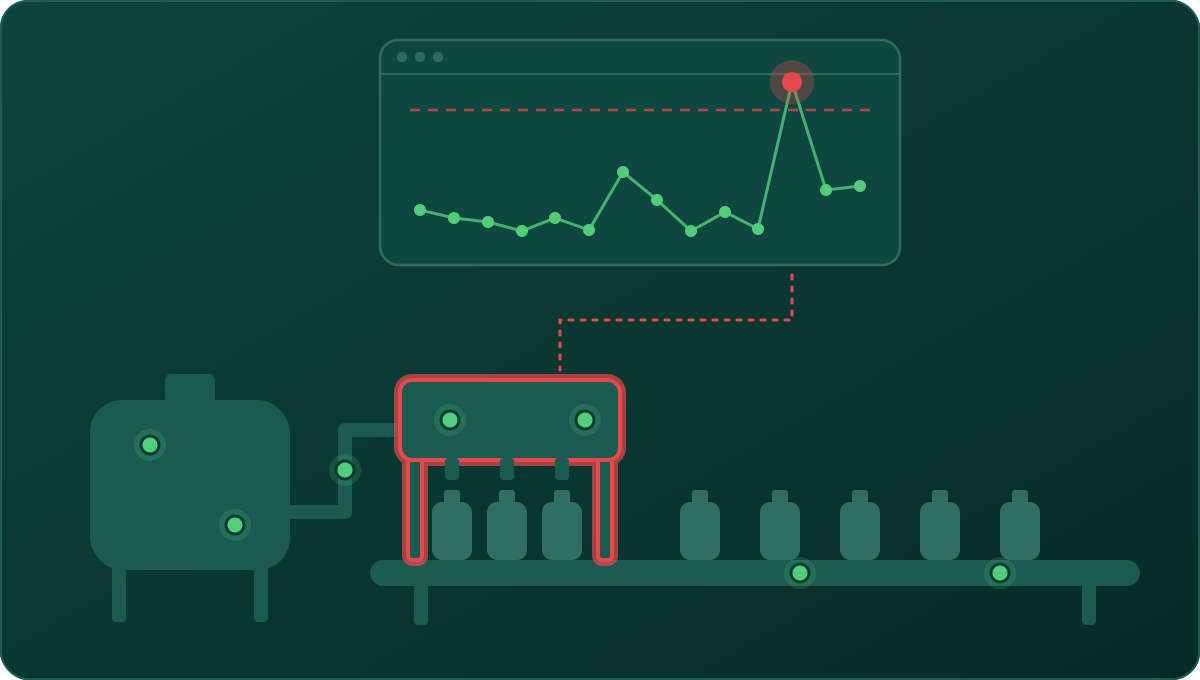
We improve the quality of your processes, reduce waste and speed up the development of new products. Together with your team, and starting from the data you already have.
See how we do it
01 · Common challenges
Are you facing any of these challenges?
These are common questions in production, process, quality and R&D. Choose an area and look for the one closest to what happens in your plant.
Quality and variability
Quality changes with the same recipe
3 questions
Why do we get different quality results when we manufacture with the same recipe and the same parameters?
We relate what changes from one batch to another (raw material, operating conditions, shifts) to the final quality to identify which variables explain those differences.
Can we find out which production conditions are causing our quality defects?
We analyse the manufacturing history together with the quality results to identify the conditions associated with the defects. When the cause needs to be proven, we design tests to confirm it.
Can we anticipate that a batch will not meet specifications before we finish manufacturing it?
In some processes it is possible to estimate the result with the measurements available during manufacturing. It depends on there being informative signals and representative data, and we assess this with you before proposing it.
Why do some raw materials generate more waste than others, even though they have passed incoming inspection?
A batch that meets the specification is not guaranteed to behave the same way in your process. We study which properties make the difference and whether it is worth reviewing the purchasing specification or adjusting the recipe.
Can we anticipate the yield we will get from each batch of raw material before we use it?
We relate the properties of each batch to the yield obtained to find out which ones have an influence and whether they allow it to be estimated in advance.
Can we reduce the raw material used without compromising final quality?
With process models and design of experiments (DoE), we study how far the formulation can be adjusted while meeting the quality requirements. Changes are validated in the plant before they are implemented.
Productivity and costs
Unexplained yield losses
3 questions
What factors are causing the yield losses we cannot explain?
We bring together raw material, process and quality data, which are usually held in different systems. Many losses can only be explained by cross-referencing them.
Why is one production line more efficient than another making the same product?
We compare the operating conditions of both lines with their results to find what sets them apart and what can be transferred from one to the other.
Can we increase production capacity without harming quality?
We identify which variables limit capacity and how they affect quality, to find operating conditions that balance both.
Supervision and anticipation
Too many variables to monitor
3 questions
Can we detect a deviation when all the variables are within their control limits?
Yes. ARGOS monitors the joint behaviour of the variables, not each one separately, and detects anomalous relationships that an individual control can miss.
Can we evaluate different production conditions with a model before testing in the plant?
Yes, within the conditions in which the model has proven reliable. We study scenarios and choose what is worth testing; validation in the plant is still necessary.
Can we develop a new product or formulation in less time and with fewer trials?
With design of experiments (DoE) we choose the most informative trials. This way you reach reliable conclusions sooner, with fewer laboratory and plant tests, and shorten development.
How do we transfer a formulation from the laboratory to production without starting from scratch?
We build on what has been learnt in the laboratory or pilot plant and study what changes when scaling up, to guide the first industrial trials.
02 · How we work
How do we work with your team?
We start from the data your plant already records and the knowledge of your team. If data is missing, we plan trials using design of experiments (DoE).
01 · UnderstandWe agree on the challenge, the indicator and its economic impact.
02 · TraceWe bring together raw material, process and quality data.
03 · AnalyseWe study the history with explanatory models and check it against plant experience.
04 · ImproveWe propose changes and measure their effect against the starting point.
Once the process has been improved, ARGOS monitors its behaviour continuously. It compares new data with the reference for good operation and, if something deviates, shows which variables to review.
Not necessarily. What matters is having data that is relevant, reliable and related to the process. First we assess the information available and whether it can answer the challenge. If important data is missing, we define what is worth starting to collect.
Do we have to install new sensors or change our systems?
Not always. We start from the information the plant already generates. We only propose new measurements when they are needed to answer the challenge and justify their cost.
Can you work with our data if it is spread across Excel, SCADA, ERP and the laboratory?
Yes, as long as it is feasible to access it and establish the necessary traceability. An important part of our work is structuring and aligning the information to relate raw material, manufacturing conditions and quality results.
Can you recommend which parameters to change?
Yes, when the data and the model are suitable. First we build a model that explains how raw material and process conditions determine quality, yield or cost. Then we use it in reverse: we start from the results you need and calculate which operating conditions make it possible to achieve them. The recommendations respect the real constraints of the process and are validated in the plant before they are implemented.
Do you use “black box” artificial intelligence?
No. In manufacturing, predicting is not enough: you need to understand how the variables relate to each other to know which lever to pull. We use models that show what influences the result and to what extent, so that your team can check it, decide and sustain the improvement.
How will we know whether the project will pay off?
We start by defining the challenge, its economic impact and the indicator used to measure it. We measure the starting point and compare the result of the improvement against it.
What will you need from our team?
A contact person, access to the records, and the production conditions and limits. We work with production and quality so that every decision fits in with day-to-day operations.
Will we be able to work without always depending on Kensight?
We work alongside the people who know the process and share the methodology and tools with them, so that they gain autonomy in the analysis, improvement and supervision of their operations.
Case study · Familia Martínez
Studying scenarios before testing in the plant
The Familia Martínez quality team explains how they work with Kensight to keep their products consistent.