Raw material purchasing specifications usually set an acceptable range for each property separately. It is a criterion that is easy to apply and to negotiate with suppliers, but it does not guarantee that the accepted raw material will perform well in the process. In this article we explain why, and what a multivariate specification consists of.
The limitation of property-by-property specifications
A classic specification is a list: moisture between two values, content of a component above a minimum, particle size within a range. If all the properties comply, the batch is accepted; if any does not, it is rejected or negotiated.
This logic assumes that each property influences the process independently. In practice this is rarely the case. The properties of a natural raw material or a chemical intermediate are related to one another, and their effect on yield depends on how they combine. This has two consequences:
- Accepted batches that perform poorly: each property is within its range, but the combination is unfavourable. For example, if two properties are both close to their limit in the direction that penalises the process, the joint effect can be much greater than that of each one separately.
- Rejected batches that would have performed well: one property falls slightly outside its range, but the others compensate. The batch is rejected or penalised unnecessarily, which makes purchasing more expensive and strains the relationship with the supplier.
Moreover, widening or narrowing the individual ranges does not solve the problem: narrowing them reduces the bad combinations at the cost of rejecting many good ones, and widening them does the opposite.
A region instead of a box
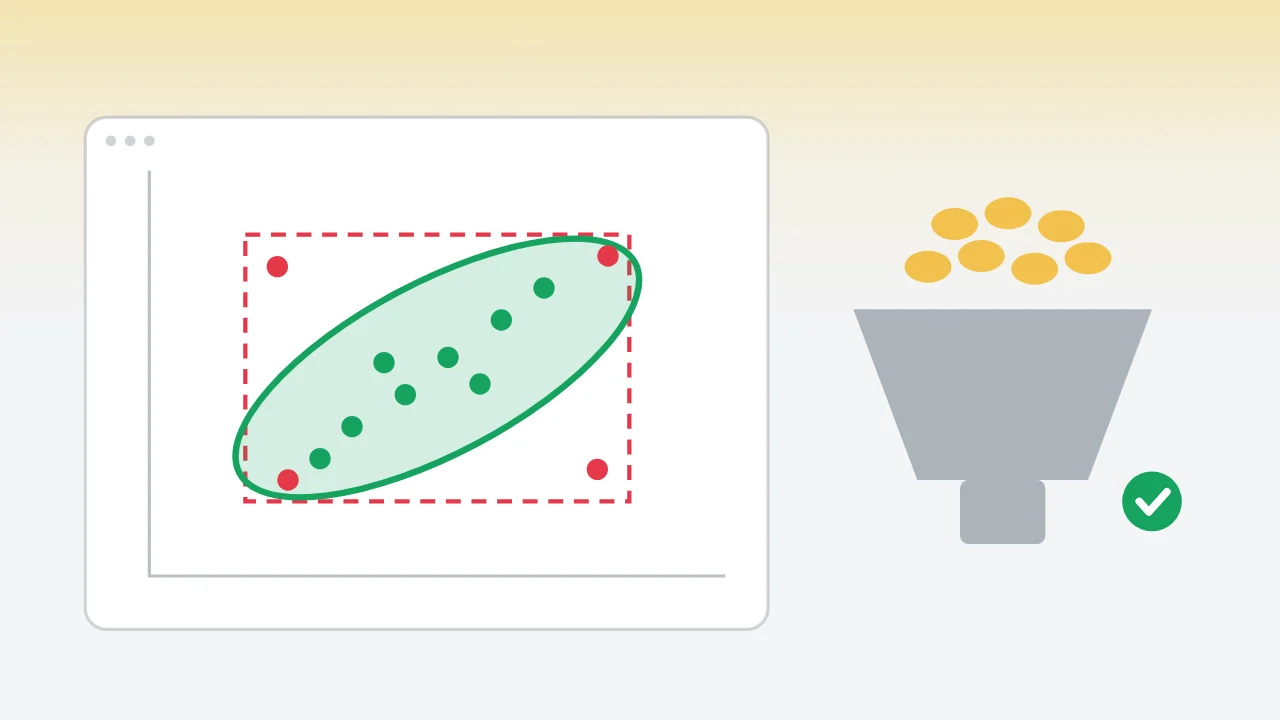
If you plot two properties on a chart, the individual ranges form a rectangle: the acceptable zone is the box bounded by the four limits. When the properties are correlated and their effect is joint, the zone in which the raw material performs well is not box-shaped. It may be a sloping band, an ellipse or a more irregular region, and with more than two properties it becomes a volume in a multidimensional space.
A multivariate specification defines that region directly. Instead of asking whether each property is within range, it asks whether the batch’s combination of properties falls in the zone where the process achieves the target yield. The box and the region largely overlap, but they differ precisely at the corners and edges, which is where the batches that are wrongly accepted or rejected today are found.
To build that region you need a model that relates the properties of the raw material, and where relevant the process conditions, to the result. Multivariate techniques based on latent variables are particularly suitable, because they handle correlated properties well and show what has an influence and to what extent. And since the model can be run in reverse, from the target yield to the input properties, it is possible to delimit which raw material combinations are compatible with that target.
Taking model uncertainty into account
No model predicts without error. If the region is defined using only the mean predictions, a significant share of the batches near its edge will perform below expectations. For a purchasing specification, that risk is not acceptable.
That is why the region must be built taking the uncertainty of the predictions into account: it is not enough for the expected yield to be sufficient; it has to be so with a level of confidence that the company considers appropriate. The higher the confidence required, the more conservative the region. The level chosen is a business decision that balances the risk of accepting bad batches against the cost of rejecting good ones.
You also have to respect the scope of the model. Outside the combinations of properties observed in the historical data, predictions are unreliable. A good multivariate specification does not extrapolate: it is limited to the zone in which the model has information.
What you gain from a multivariate specification
- Fewer losses in the process: it filters out the unfavourable combinations that pass incoming inspection today.
- More purchasing flexibility: you can accept batches that, even if they fall outside an individual range, are compatible with the target yield.
- Better dialogue with suppliers: the conversation shifts from
this value is out of range
tothis combination affects our process
, which is more useful for both parties. - Decisions before production: knowing how a batch is likely to perform, you can decide which product or line to allocate it to, or how to adjust the process.
For example, in a starch extraction plant, a multivariate purchasing specification designed to ensure yield with at least 90% confidence reduced waste from 12% to 4%. You can see other examples of projects in case studies.
How to put it into practice
A multivariate specification does not have to complicate day-to-day incoming inspection. The calculation uses the same analyses that are already carried out, and the result can be presented as simply as the classic specification: the batch is either compatible with the target yield or it is not, with an indication of which properties weigh most in the decision.
It is advisable, however, to introduce it gradually: first in parallel with the current specification, to compare decisions and build confidence, and then as the main criterion. And to review the model periodically, because suppliers, origins and the process itself change.
What to do first
- Gather the history: incoming analyses for each raw material batch and the yield of the process in which it was used, with a common reference that allows them to be linked.
- Review the doubtful decisions: look for accepted batches that performed poorly and batches that came close to rejection and performed well. If there are many, the current specification has room for improvement.
- Look at the properties in pairs: plotting yield against pairs of properties often already shows whether the good zone is box-shaped or not.
- Agree the confidence level: decide with purchasing and production what risk you are willing to take; it will be the starting point for building the region.